Watch The Birds, Find The Tuna

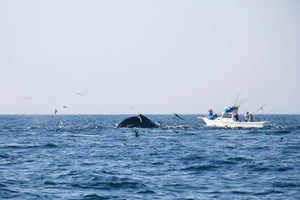
Storm Petrels, Shearwaters, and other sea birds join in on a whale and tuna feeding frenzy.
With warm waters and relatively calm seas, July is a great month for offshore fishing, especially when it comes to pursuing various species of tuna. No matter where you fish, however, probing open ocean waters for big game catches presents some special challenges.
Obviously, there’s the time factor. While bluefin these days will sometimes come surprisingly close to the beach requiring only a short run of eight to ten miles, most offshore trips are full-day or even overnight adventures where other tunas and billfish are concerned. The large size of many offshore predators also requires top-shelf gear, including heavyweight rods, reels, lures, lines and accessories if you hope to have a reasonable chance of decking or tagging any of the bigger species available.
Perhaps the greatest challenge, however, is simply finding the fish. There’s a lot of water to cover once you get a few miles off the beach and your quarry can be just about anywhere. That makes having reliable reports and some coordinates from which to begin your search important elements of any serious offshore fishing plan.

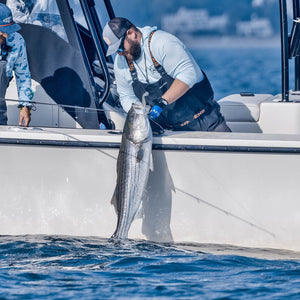
Dropping jigs amongst a flock of "tuna chicks" led Jeff and Ethan to a battle with this big bluefin 8 miles off the beach.
Of course, even the freshest reports and best sets of numbers serve as no more than starting points. Unless you have a buddy that’s engaged and willing to clue you in on the action (or stop by the shop where that info is always available free of charge), the onus is on you to find the fish once you reach wide-open spaces. To that end, patience may not always be a virtue. Some skippers will begin their search by trolling in a grid pattern, covering their primary area before pushing out in the direction where recent catches were known to be headed. Others simply get up and go, speeding off on a beeline to the next logical hot spot—be that a temperature break, wreck, or significant change in bottom contour.
Those are logical and time-proven approaches, but in route, you’ll want to keep your eyes on the horizon, constantly watching for diving birds as they can be a shortcut to some serious action. The key is letting the birds tip you off not only to the presence of predator species but to their behavior as well.
Herring and blackback gulls, for example, are large, lazy birds and not fast enough to keep up with tuna on the move. Find them diving and you’ll know the tuna are mostly staying in place while feeding on or near the surface. That means you may be able to quietly drift or lightly power into position if using bait or jigs, or troll in a pattern that brings your lures beneath the birds while keeping the boat on a course that won’t spook your prey.
Shearwaters, by comparison, are fast-moving diving birds that can actually work baitfish into tight balls on their own. That means there may or may not be predator species feeding beneath - but it’s a good idea to check. Whereas gulls usually indicate feeding activity near the surface, shearwaters can dive more than 50 feet deep, so be prepared to get your baits and lures down well below the surface as you approach. If you don’t hook-up within a few minutes, it might make sense to keep on moving.
Another bird to key on is the storm petrel. They don’t specifically follow tuna and game fish around, but they do feed on some of the smaller baitfish for which bigger predators have a sweet tooth - sand eels for example. Seeing a couple of “tuna chicks,” as these birds are known to the offshore set, doesn’t necessarily call for further investigation. Seeing a large group, however, may indicate a heavy concentration of baitfish. Find the bait and, well, you know the rest.
Although they’ll sometimes set up on smallish baits that have no other predators in pursuit, terns can also be the gems of birds when it comes to finding predators on the prowl. They can see 30- to 40-feet deep and often fly in a wedge pattern simulating the way tuna schools move beneath the surface. In this case, you’ll often find the lead tern right above the lead tuna. If you aren’t seeing fish breaking on the surface beneath the birds, push on to get a comfortable distance ahead of the lead. Now, cast a big diamond jig across its path and let the lure drop for a count of 10 or more before snapping it to life. Time things right and you might finish the day with sore arms, a tired back, a happy crew, and tuna steaks for all aboard.
- Bryce Poyer