Shake Hands with Fat Albert, Part II

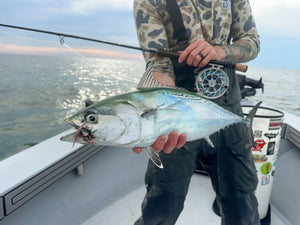
Albies might just be the perfect fly-rod fish. Photo by Jeff Lomonaco.
Picking up where we left off in Part I, fly gear for albies doesn’t need to be overly complicated—but it does have to be saltwater-tough and operationally smooth. We recommend a fast-action saltwater fly rod (intermediate to advanced) paired with a matching saltwater fly reel that features a smooth drag, plenty of backing, and a quality intermediate or a float/hover intermediate (FHI) fly line like the Rio Outbound Short.

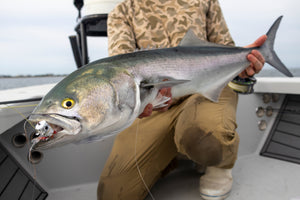
Epoxy baitfish, corner pocket. Photo by Jeff Lomonaco.While 8- and 9-weight fly setups are favored by most albie anglers, your choice should depend largely on where you fish and whether you are an albie purist or also pursue stripers and bluefish throughout the season. Go with the 8-wt if you are hyper-focused on false albacore. Give the nod to the 9-wt if larger blues and stripers frequently figure into your plans as well, or if you spend a lot of time on breezy open waters. It will provide the extra power needed to punch the small, aerodynamic baitfish patterns albies relish through the wind in demanding areas like Montauk, Shinnecock Inlet, the South Shore surf, eastern Long Island Sound, and open ocean waters. A 9-wt also has more backbone when it comes to turning larger stripers and "gator" blues—certainly a consideration during the height of the fall run.
Dedicated fly-fishing brands like Sage and Redington offer excellent choices in both the 8- and 9-wt fly rod and reel categories, but we also carry plenty of other options and a full lineup of fly-fishing gear, making it easy to match both your needs and your budget. Stop by the shop if you aren’t quite sure what you need, and we’ll help put together the perfect setup tailored to your fly-fishing style.
In terms of fly patterns, sparsely tied 3- to 4-inch minnows sporting a touch of silver Mylar or Flashabou are reliable producers. Some of our favorites include Rio's Nice Glass Flies, Enrico Puglisi Ghost Minnows, and Bay Anchovies. LI Flies Surf Candies, Albie Wh*res, and Rainy’s Clouser Flies work well too, as do simple white, olive, and olive/white epoxy minnows.

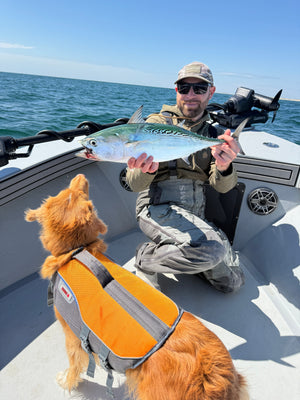
Some anglers are so obsessed with these fish that they even name their dogs after them—meet Tunny. Photo by Jeff Lomonaco.
Of course, there’s no point in having great gear if you can’t figure out how to make these speedsters bite. So, let’s cut to the chase, since that seems to be the biggest problem area for novice false albacore fans.
The first thing to keep in mind for both fly-rodders and the spinning crowd is that these fish spend their days in high-speed pursuit of schools of prey—so timing is everything. You need to get ahead of the pod to make several casts before it moves on. If possible, lead your targets by several feet using a quick, unbroken retrieve that keeps your offering skipping over the surface or riding just below (fly-rodders should use a two-handed striping retrieve). The idea is to race your temptation across the paths of the pack leaders. If an albie decides to strike, you’ll know; there is no finesse about the take so set the hook instantly.
Should the above option fail, you can also try casting just behind the lead fish and simply allow your lure or fly to fall through the pod without a twitch or crank of the reel. Count to five or six to ensure your lure has dropped far enough, then retrieve it quickly back to the surface for a few skips and repeat.
Another trick that can be used when fly casting is a dead drift. This allows your imitation to look like a stunned baitfish sinking toward the bottom. In this case, use a steady count of 20 to allow your pattern to sink unimpeded before recasting. If that doesn’t work after a few casts, try adding a very slight twitch or two as your offering settles under the surface. Twitch just hard enough to give your fly a death shiver.
If any of the above scenarios draw a take, drive the hook home with a firm strip strike or rod snap and hold on tight as your quarry sizzles away. To prevent breaking off on that first blistering sprint, keep your rod at a low 30- to 40-degree angle so the drag pulls smoothly. Remember, you want to provide enough resistance to make the fish work hard, but not enough to pop the leader. Once that first run finally subsides, gradually raise your rod tip to let the deeper section of your blank do more heavy lifting.

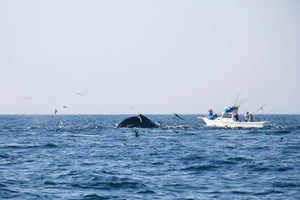
Send ’em back into the green—headfirst and hard. Photo by Jeff Lomonaco.
Because Fat Alberts are oily fish with dark red meat, most anglers consider them a catch-and-release species. Since they’ll fight until ready to drop, you’ll want to revive them immediately Be sure to “walk” any albie that appears overly fatigued by gently sliding it forward through the water to pass oxygen over its gills. Once it has recovered and regained a little strength, launch it hard and head-first back into the sea. That last part is just as vital as the first since the launch gets your trophy swimming in the right direction with purpose, increasing its chances of avoiding sharks, seals and other predators that might be lurking around.
- Bryce Poyer