Peconic Bay's Porgy Pandemonium

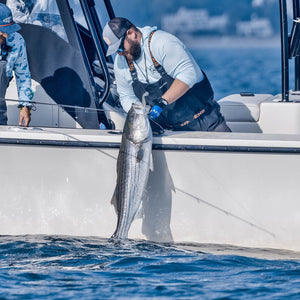
Carlos Sanchez finessed this fine Peconic Bay Scup aboard the open boat Fin Chaser. Credit: myfinchaser.com
While some East End saltwater inshore anglers get their fishing season underway in April, quite a few wait on May to make their first excursions of the new year. That shouldn’t come as a surprise when you consider May delivers on April’s tease with warming trends, gentle winds and fishing promise fulfilled more often than not. By the start of the month, most of the early season players should already be on the scene including stripers, blues, weaks, fluke and porgies. While all have loyal followings, it’s the porgies that really shine for anglers who need to stack some tasty fillets in the freezer or simply want to feel a tug at the end of their line.
A favorite species for kick-starting the East End season due to their vast numbers and aggressiveness even in mildly cold waters, porgies are a great choice from beach or boat. On Peconic Bay specifically, the scup, as porgies are also called, run pleasingly large from May into June with 12- to 14-inch-fish common and larger ones to 17 inches a distinct possibility.
Just how good is this early-season action? Good enough to entice several open boat operations to actually move their vessels to Greenport and Jamesport for the run. Other boats make daily runs to the fishing grounds from Orient Point, Shinnecock Bay, Sag Harbor and even Montauk. There’s also a vessel or two that cruise over from Connecticut to join the fun. Indeed, between the size of the fish, the reliable action, and a fleet consisting of private, charter and open boats, the scene can accurately be described as porgy pandemonium.
 It’s hard not to smile when jumbo porgies are coming over the rail of the open boat Celtic Quest.
Credit: Celtic Quest Fishing
It’s hard not to smile when jumbo porgies are coming over the rail of the open boat Celtic Quest.
Credit: Celtic Quest Fishing
Interestingly, the porgies flooding into the bay at this time of year aren’t necessarily there to feed. For them, spawning is the draw. That means when they first arrive they may set up differently than you’ll see during mid-summer or fall. Whereas the best of the later action is often concentrated around noticeable structure like a wreck, ledge or well-defined hole, spring offers solid action over relatively sandy, flat and clean bottom with perhaps a bit of gravel or a mussel bed serving as the anchor point for the biggest schools.
“I like to look for them along the 30-foot curve anywhere between the Greenlawns on the west side of Shelter Island, Jessup Neck, and the mouth of Noyak Bay,” reveals Capt. Keith Williams of the open boat Fin Chaser. His vessel hails from Montauk but spends each May departing from Preston’s Dock at the foot of Main St. in Greenport.
“It’s amazing how big and plentiful Peconic porgies are this time of year,” says Williams. “Once things get rolling and the water temperatures push into the mid-fifty-degree range, they’ll grow increasingly aggressive - but those first couple of weeks, when water temps are still a little colder, you’ll need to use a little finesse to keep up with the sharpies.”
To that end, Williams suggests his fares us small baits. “Many anglers like bloodworms and sandworms for bait,” he explains. “They work well because you can’t over-bait your hook with them. But a small piece of clam is equally effective. These fish are here to spawn not to gorge themselves full. To interest them before that happens, you’ll want to trim the size of your baits, bounce or lift them slowly along the bottom, and set the hook if you feel the slightest bump or extra weight at the end of your line. The bump is the bite when the season first opens. That’s the thing to keep in mind.”

Frank Morris of Delaware with a fine Peconic Bay scup taken aboard the open boat Fin Chaser. Credit: myfinchaser.com
Capt. Matt Gilbert from the Peconic Star Fleet, will be sailing from the fleet’s long-time home base at the Greenport Rail Road Dock. He’ll be chasing dinner-plate-sized porgies from the Peconic Star VI, which has just been added to the fleet. Some of you might remember this vessel as the Ebb Tide out of Montauk. If so, you know this boat can catch. So can this skipper. Also new to the fleet as it celebrates its 46th year is the newly commissioned Yank Marine vessel, Peconic Star VII. This boat will be dedicated to charter and cruise trips including fishing adventures, reunions, corporate retreats, bachelor parties, family getaways and more.
Like Williams, Gilbert suggests anglers chop down the size of their baits. “A little clam is all you need,” he states. “I like white clams (surf clams) better than rainbow clams (skimmer clams). The rainbows are harder for porgies to pick off the hook, but the surf clams are soft, juicy and release a nice scent trail. Either way, thread a small piece of hard body onto the hook’s shank, then gently wrap some clam belly around it. The jumbos can’t resist that kind of offering.”
Gilbert also cautions anglers to gently lower their baits to the bottom when at anchor to prevent ripping the clam belly off before reaching the strike zone. Another tip he offers, this one for private boaters, is to look shallower if the bite doesn’t materialize on a cool spring day. “Shallow depths,” he notes, “warm-up quicker than deep water and a couple of extra degrees can make a huge difference in the action.”
Capt. Desmond O’Sullivan, who has long been cashing in the Peconic’s Jumbo spring porgies by bringing the Celtic Quest from its Long Island Sound locations to Jamesport for the month of May, also had a couple thoughts to offer. “Once you are on the porgies, you’ll figure out how to catch them, but the key is to zero-in on a school first,” he advises. To that end, O’Sullivan stresses that every year is different - and the fish can set up in a variety of areas anywhere between Jessup Neck and the Greenlawns on Shelter Island.

Capt. Matt Gilbert shows off a tiderunner-class Peconic Bay weakfish. Weakfish, fluke and occasional puffers are among the by-catches you’ll encounter aboard the open boat Peconic Star VI while targeting May’s jumbo porgies.
“Sometimes we’ll find the best fishing in 50- to 60-foot depths, other seasons they set-up more often in 25-foot depths,” continues O’Sullivan. “The point is, you don’t have to start in the exact same spot every year. Take some time to ‘machine around,’ using your electronics and look for ground fuzz on the bottom. If you find that fuzz, be patient. You may have to wait for the right stage of the tide before the action hits stride. Generally, scup bite best in moving current and slow down on the slack.”
Capt. Des also noted that chumming requires a little extra effort on the part of private boaters but can really influence your results in a positive way. “A log of ground chum lowered to the bottom in a chum pot can really kick things into high gear,” he states emphatically.
Gearing up for porgies and a by-catch of weaks, fluke and maybe even a puffer or two isn’t tough to figure out. A versatile inshore setup that can handle the biggest scup as well as any likely extras can run along the lines of a 7-foot Jigging World Black Widow rod (BLW-701-120.2.0 CFG matched to a Daiwa Saltist 15 or Shimano Troium Star Drag 14 (TOR14HGA) conventional reel filled with 20-pound test Daiwa J-Braid x4 Braided Line. Add a 2-Hook Porgy Bottom Rig, with size 2 hooks anchored by a 2- to 4-four ounce sinker, and you are set to go.
For a little more challenge you can also jig your scup on a ¾ to 1.5-ounce Joe Baggs Lay Perfect Blackfish Jig, especially if the tide is pushing lightly. Bait-up the jig just like you would a regular porgy hook and crawl the jig slowly across the bottom. Private boaters may also be able to get away with medium-weight spinning gear if they want a little extra challenge, but conventional gear gets the nod on open boats due to superior line control that can help you avoid tangles.
- Bryce Poyer